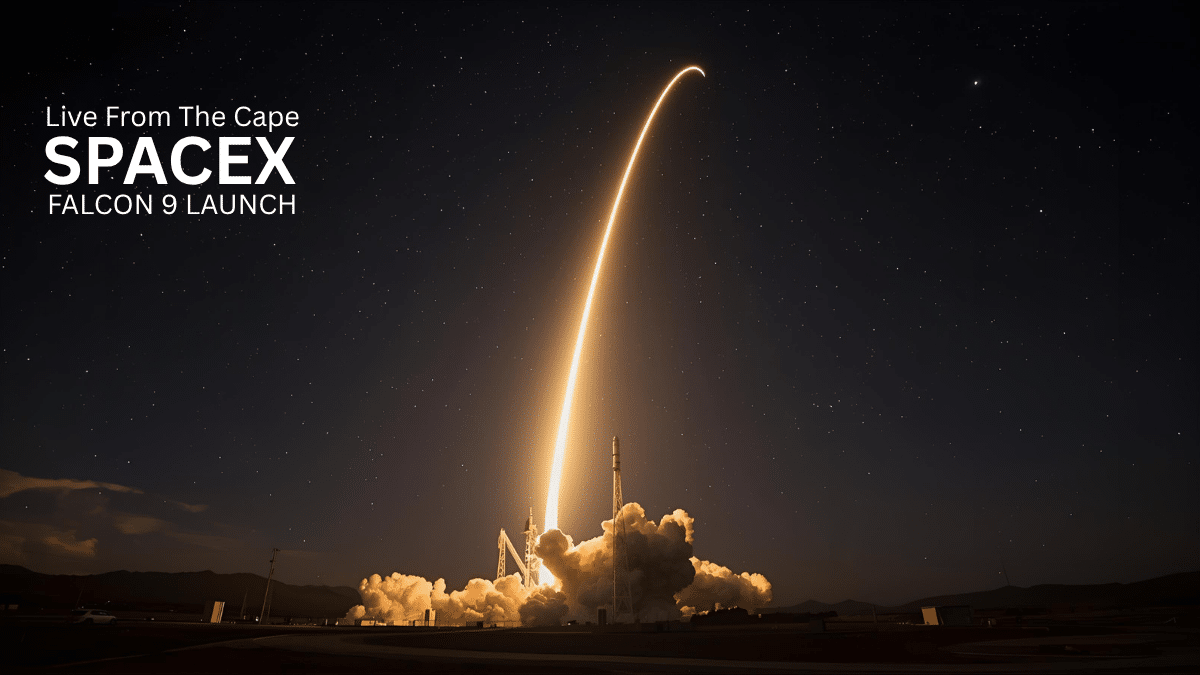
SpaceX Falcon 9 rocket launches 21 Starlink satellites into orbit early Friday, marking another milestone for Elon Musk’s reusable launch system and expanding the ever-growing Starlink internet constellation. The latest rocket launch today lifted off from Vandenberg Space Force Base in California at 12:33 a.m. PDT (07:33 UTC), lighting up the West Coast skies.
Table of Contents
Spacex Falcon 9 Rocket Launches 21 Starlink Satellites
The Falcon 9 launch successfully deployed 21 new Starlink V2 Mini satellites into low-Earth orbit (LEO). These advanced satellites will enhance broadband coverage and bandwidth across North America, Europe, and parts of the Asia-Pacific.
According to SpaceX, the first stage booster, identified as B1071, completed its 15th flight and landed safely on the droneship “Of Course I Still Love You” stationed in the Pacific Ocean. The smooth booster recovery reinforces SpaceX’s reputation for reusable rocketry—key to its long-term rocket launch schedule and cost efficiency.
Launch Details and Mission Highlights
This mission, officially named Starlink Group 10-3, was part of SpaceX’s ongoing effort to expand its satellite internet constellation, now exceeding 6,300 active satellites in orbit. The liftoff was visible along the California coastline, thrilling local observers and online viewers watching the rocket launch live feed on SpaceX’s official X account (@SpaceX).
Weather conditions at Vandenberg were near perfect, with clear skies ensuring a picturesque ascent. The entire mission—from liftoff to payload deployment—was completed in just 64 minutes.
Why the Launch Matters for Space Connectivity
The starlink satellite deployment underpins SpaceX’s goal to provide global high-speed internet, particularly in remote and underserved regions. The new generation V2 Mini satellites boast improved laser links and higher data capacity, enabling faster communication between satellites without relying on ground stations.
This latest success aligns with SpaceX’s broader ambitions, including its Starship launch development program. The company continues to maintain a tight cadence within its next spacex launch pipeline, averaging nearly two missions per week in 2025.
What’s Next on the Rocket Launch Schedule
Up next, SpaceX plans another Falcon 9 launch from Cape Canaveral Space Force Station in Florida later this week, carrying additional Starlink satellites. Fans eager to watch can follow the spacex launch today live countdown via the company’s YouTube and X channels.
For readers following long-term developments in orbital infrastructure, NASA has also announced plans to retire the International Space Station by 2030—read more on that major transition HERE.
Expert Insights and Reactions
Space analyst Jonathan McDowell commented, “SpaceX’s consistency in orbital launches demonstrates an unprecedented industrial scale in space access.” NASA officials praised the private company’s precision timing and recovery efficiency, reinforcing SpaceX’s dominance in the space launch today sector.
The reusable Vandenberg Falcon 9 booster system continues to save millions per mission, proving the economic sustainability of commercial spaceflight.
Growing Momentum for Reusable Rockets
With this operation, SpaceX has now logged 134 successful launches in 2025 alone, further tightening its grip as the world’s leading commercial launch provider. Each mission contributes not only to Starlink’s expansion but also to the company’s broader strategy supporting NASA, defense, and private payloads.
The launch from California also underscores how SpaceX is balancing its operations between the West and East Coasts to maximize turnaround and minimize delays within its rocket launch schedule.
Conclusion: SpaceX Sets New Standards in Orbital Frequency
The SpaceX Falcon 9 rocket launches 21 Starlink satellites mission exemplifies the company’s ability to execute high-frequency, low-risk launches with remarkable precision. As the Starlink network grows and next spacex launch plans unfold, the world watches each rocket lift-off today with renewed fascination for humankind’s accelerating journey into orbit.