Introduction
Cricket is often described as a game of fine margins—where the faintest edge can change the course of a match. Over the years, technology has stepped in to help umpires make more accurate decisions, and one such innovation is the snickometer in cricket. From nail-biting Test matches to high-stakes T20 encounters, the snickometer has become a trusted tool for detecting faint edges that are almost invisible to the naked eye.
But how exactly does it work? And why is it so important in today’s cricket landscape? Let’s dive deep into its evolution, technology, controversies, and impact on the game.
Key Points (Quick Summary)
- The snickometer in cricket uses sound analysis to detect faint bat-ball or bat-pad contacts.
- It plays a crucial role in the Decision Review System (DRS), especially for caught-behind appeals.
- Introduced in the 1990s, it has evolved into UltraEdge technology for better accuracy.
- Players and fans often debate its reliability compared to Hawk-Eye and ball-tracking systems.
- Snickometer continues to shape the future of umpiring in cricket, ensuring fair outcomes.
Table of Contents
The Evolution of Snickometer in Cricket
Early Days of Cricket Technology
In the 1980s and 1990s, cricket broadcasts were becoming more advanced, and technology slowly began influencing decision-making. The snickometer was first introduced in the mid-1990s by English scientist Allan Plaskett, aiming to help TV audiences see whether a batsman had edged the ball.
At the time, it was a purely broadcast tool—not used for official umpiring decisions. Fans loved the added drama, but umpires relied on instinct and human judgment.
Integration into the Decision Review System (DRS)
Fast forward to 2008, when the Decision Review System (DRS) was launched. By then, the snickometer had become more refined and was incorporated as a key element in third-umpire reviews. Alongside Hawk-Eye and Hot Spot, snickometer became central to overturning or confirming close calls.
How Does the Snickometer Work?
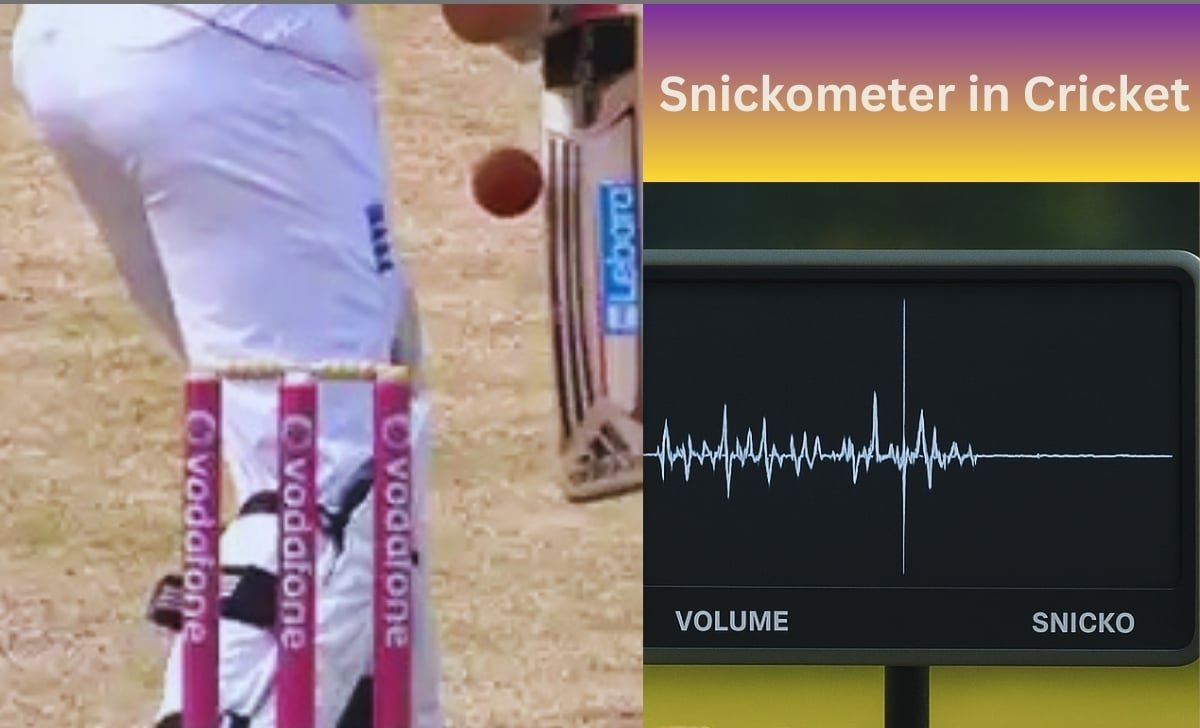
The snickometer in cricket works on a simple but powerful principle: sound-wave detection.
- Microphones placed in stumps pick up all sound activity near the batsman.
- These sound waves are analyzed by software, producing a waveform graph on TV replays.
- If the ball grazes the bat, pad, or glove, it produces a sharp spike in the waveform.
- The third umpire matches the timing of the ball’s passage with the sound spike to decide if there was contact.
This makes it particularly useful for caught-behind appeals, where even the faintest nick can decide a wicket.
Snickometer vs. UltraEdge: What’s the Difference?
Over time, broadcasters and cricket boards wanted more precision. This led to the evolution of UltraEdge, an advanced form of snickometer.
| Feature | Snickometer | UltraEdge |
|---|---|---|
| Technology | Sound analysis | Enhanced sound-wave + visual sync |
| Speed | Slower processing | Real-time processing |
| Accuracy | Reliable but occasional delays | Higher accuracy with HD sync |
| Usage | Early DRS years | Current global standard |
Today, UltraEdge is the official version used in ICC tournaments and bilateral series, though fans still often call it the “snicko.”
Why Snickometer Matters in Modern Cricket
1. Ensuring Fair Decisions
In a game where careers and match outcomes hinge on split-second moments, the snickometer ensures fairness. It reduces umpiring errors and provides a scientific backup for contentious calls.
2. Supporting the Umpires
On-field umpires face immense pressure, especially in noisy stadiums where even edges aren’t audible. The snickometer acts as a silent partner, giving them confidence in decisions.
3. Fan Engagement
Nothing excites fans more than watching the waveform spike on the big screen during a DRS review. It adds drama, anticipation, and trust in the process.
Also Read: AI and Analytics In Cricket
Limitations and Controversies
No technology is perfect, and the snickometer is no exception.
- False Spikes: Sometimes, bat hitting the pad or ground produces misleading spikes.
- Sync Issues: Earlier versions struggled to align the ball’s passage with sound spikes.
- Reliability vs Hot Spot: In certain cases, Hot Spot (infrared imaging) gives clearer evidence of contact.
For example, during the 2013 Ashes series, several decisions sparked debates about whether snickometer alone was enough, prompting the ICC to promote UltraEdge as the standard.
The Future of Snickometer in Cricket
As cricket becomes more global and technology-driven, the snickometer will continue to evolve. Possible advancements include:
- AI-enhanced detection that can differentiate between bat, pad, and ground noise.
- Integration with 5G real-time feeds for instant reviews without delays.
- Augmented reality overlays for fans in stadiums, showing edge detection live.
In the coming years, we can expect the snickometer (and its successors) to make umpiring even more foolproof.
Stats & Usage of Snickometer
- According to ICC data (2023), over 28% of DRS reviews involve caught-behind appeals, where snickometer/UltraEdge plays a key role.
- In the IPL 2024 season, snickometer contributed to overturning 41% of incorrect on-field decisions (as per ESPNcricinfo analysis).
- A 2022 study on cricket technology found fan trust in DRS rose by 33% after UltraEdge became the standard.
These figures highlight how deeply ingrained the snickometer is in cricket today.
Conclusion
The snickometer in cricket has transformed the way decisions are made in the sport. What started as a broadcast innovation is now an integral part of the Decision Review System, ensuring accuracy, fairness, and transparency.
While not flawless, its evolution into UltraEdge technology shows cricket’s commitment to using science for better umpiring. In a game where a faint nick can decide a championship, the snickometer remains one of the most trusted allies of players, umpires, and fans alike.
As technology continues to evolve, one thing is certain—the snickometer will keep shaping the future of cricket, one edge at a time.
FAQs
Q1: What is snickometer in cricket?
The snickometer is a sound-based technology that detects faint bat-ball or bat-pad edges using stump microphones and waveform analysis.
Q2: Is snickometer and UltraEdge the same?
UltraEdge is the advanced version of the snickometer, offering faster and more accurate results, and is now the global standard in DRS.
Q3: Can snickometer make mistakes?
Yes. Sometimes external noises, bat hitting the pad, or sync delays can cause false spikes. That’s why it’s used alongside other tools like Hawk-Eye and Hot Spot
Q4: Who invented the snickometer?
It was developed by English scientist Allan Plaskett in the 1990s for television broadcasts before being integrated into DRS.