Introduction
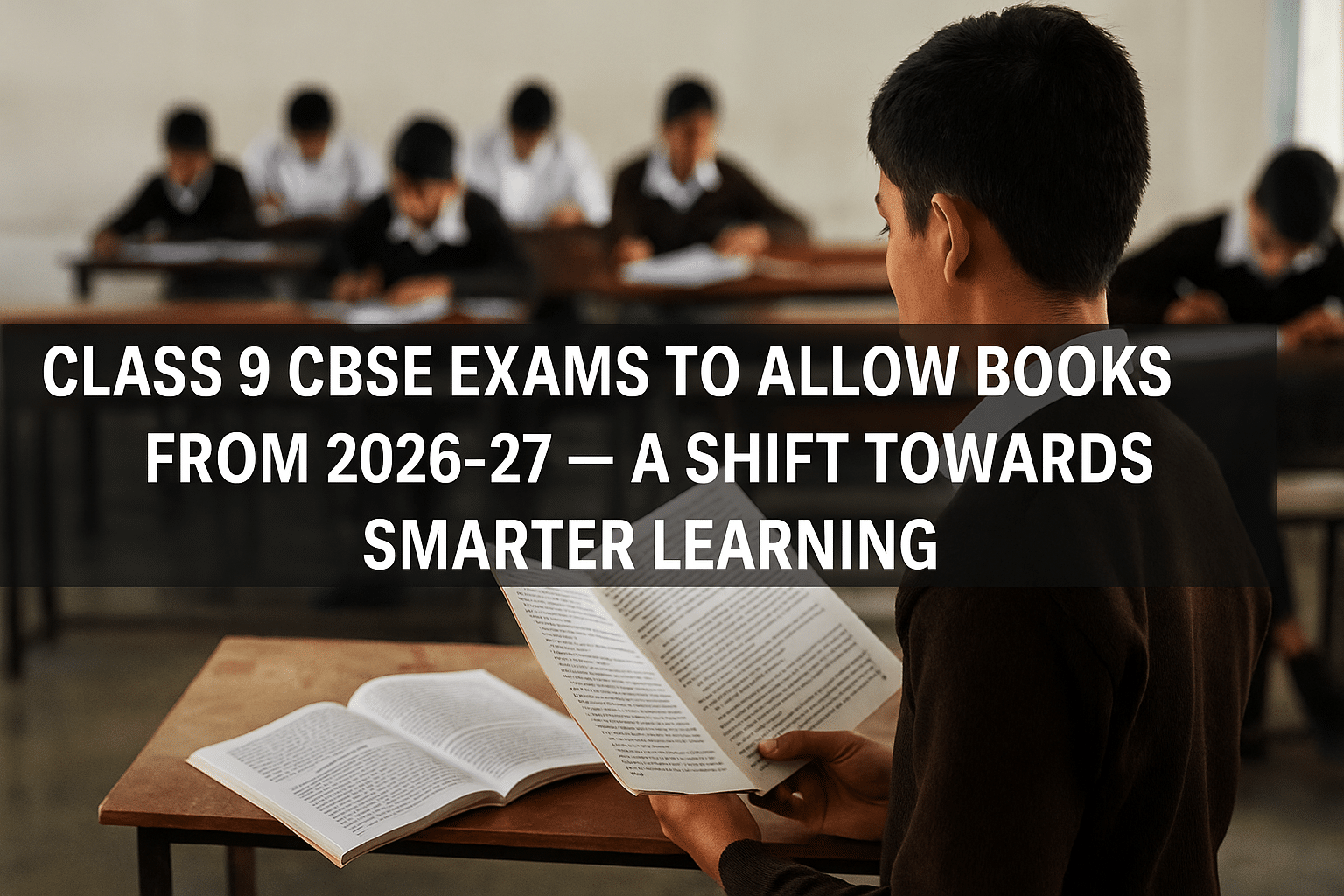
In a landmark move for India’s education system, the Central Board of Secondary Education (CBSE) has announced that from the 2026-27 academic session, Class 9 students will be able to take certain exams using their textbooks and notes. This open-book assessment (OBA) model aims to move away from rote memorization and towards a smarter, competency-based learning approach.
Table of Contents
What Is the Open-Book Assessment Model?
The open-book assessment is a format in which students can refer to approved study materials—such as textbooks, class notes, or other permitted resources—while answering exam questions. The goal is not to test memory but to measure how well students understand concepts, analyze information, and apply their knowledge in different scenarios.
In this model, simply copying text from books will not be enough. Students will have to think critically, interpret the question, and present solutions that demonstrate understanding.
Timeline and Decision Process
- Pilot Study: Before giving approval, CBSE conducted a detailed pilot program across selected schools for Classes 9 to 12. The focus was on integrating the model with the existing syllabus without adding extra materials.
- Findings: The pilot showed that student scores ranged from 12% to 47%, indicating that while some students adapted quickly, others struggled to use their resources effectively during exams.
- Final Approval: After reviewing the pilot’s performance data, CBSE’s governing body gave the green light to introduce open-book assessments for Class 9 from the 2026-27 academic year.
How the Open-Book Assessments Will Be Conducted
- Subjects Covered: The assessments will be part of three term-end internal tests for core subjects—Languages, Mathematics, Science, and Social Science.
- Format: Exams will remain pen-and-paper, but students can refer to textbooks and permitted notes during the test.
- School Choice: Adoption will be optional, giving schools flexibility in implementing the system.
- Support: CBSE will issue model papers, guidelines, and conduct teacher training programs to help institutions adapt.
Why This Change Matters
Encouraging Critical Thinking
Open-book exams test a student’s ability to analyze, evaluate, and apply knowledge rather than just recall it. This approach nurtures skills that are essential for higher education and the modern workplace.
Reducing Exam Stress
Knowing that they can refer to books reduces students’ anxiety, allowing them to focus on understanding concepts rather than cramming facts.
Alignment with Education Reforms
The decision is in line with the NEP 2020 and NCFSE 2023, both of which emphasize competency-based education and assessments that measure deeper understanding.
Challenges and Preparations
While the benefits are significant, CBSE is aware of the challenges:
- Performance Gap: The pilot study showed varying results, meaning students will need guidance on how to make the most of their resources during exams.
- Teacher Readiness: Teachers must be trained to design questions that go beyond textbook recall and assess higher-order thinking skills.
- Gradual Rollout: Making adoption optional allows time for schools to prepare infrastructure, resources, and teaching methods before full-scale implementation.
Long-Term Impact on Education
- Better Engagement: Students are more likely to participate actively in learning when they understand that exams reward reasoning and application.
- Skill Development: The format promotes skills such as critical analysis, problem-solving, and synthesis of information.
- Real-World Relevance: In real-life problem-solving, professionals often use reference materials. Open-book exams mirror this reality, making learning more practical.
The Bigger Picture
The introduction of open-book assessments is part of a broader modernization of the Indian education system. Alongside curriculum updates, skill-based programs, and continuous assessments, it represents a shift towards making education more relevant, flexible, and learner-focused.
Conclusion
The CBSE open-book assessment for Class 9 is more than just an examination reform—it’s a cultural change in how learning is measured. By prioritizing comprehension over memorization, it prepares students for academic challenges, professional demands, and real-life situations where critical thinking is key.
While there will be an adjustment period for both students and educators, the move has the potential to significantly improve the quality of education. If implemented with the right training and resources, this reform could set a new benchmark for assessments in India, fostering a generation of students who learn smarter, not harder.
FAQs:
Q1 When will CBSE introduce open-book exams for Class 9?
CBSE will implement open-book assessments for Class 9 starting in the 2026-27 academic session.
Q2 What is the main aim of introducing open-book assessments?
The goal is to move away from rote learning and encourage critical thinking, concept clarity, and real-world problem-solving skills.
Q3 What preparations will CBSE make before the rollout?
CBSE will provide sample papers, detailed guidelines, and training programs for teachers to ensure smooth implementation.
Q4 How will open-book exams be different from traditional exams?
Students will be allowed to refer to textbooks and approved notes during the exam. The questions will test application, analysis, and problem-solving rather than memorization.